Bishop guides clients with their various estate planning needs and helps them navigate the Medicaid system in Florida. Bishop also represents clients worldwide in front of the IRS. Bishop is also a V.A. accredited attorney and helps Veterans obtain benefits from the Department of Veterans Affairs.
Frederick W Daily III was an experienced tax attorney with over 50 years in the field.
Share
IRS appeals rules differ, depending on the amount of taxes you are disputing from an audit. It’s important to know at which thresholds the IRS separates requests.
Smaller cases allow for a less formal appeal request while larger cases require more in-depth communication. Below, you’ll find an overview of these two case determinations and how the IRS assesses them.
Under $25,000: Small Case Request
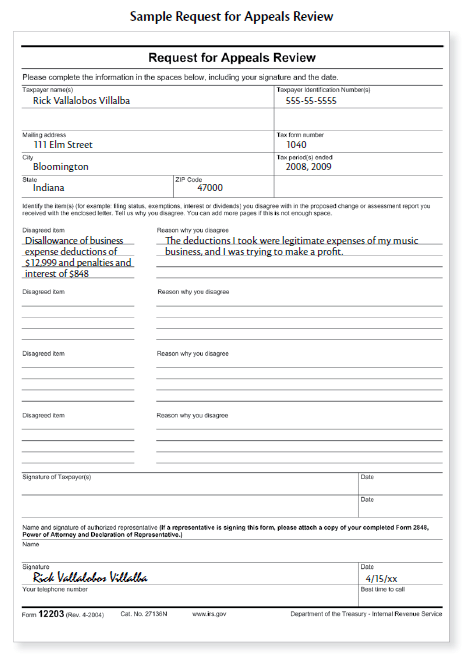
If the total amount you’re disputing for any one tax year is not more than $25,000, fill in and send Form 12203, Request for Appeals Review,(see sample below) instead of filing a formal protest letter.
Over $25,000: Formal Protest letter
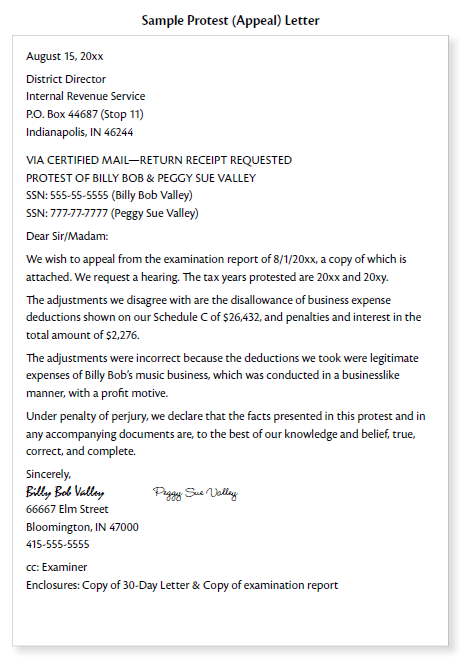
If your proposed audit bill is over $25,000, you must send a letter containing the following eight things:
Your name (and your spouse’s, too, if your joint tax return was audited), along with your address and a daytime phone number.
A statement that you want to appeal particular IRS findings to the appeals office.
A brief statement of the facts supporting your position. (See the sample below for suggestions.)
The law or authority, if any, on which you are relying—if you have it. The IRS asks for this, but don’t let that throw you; it really isn’t necessary to cite any legal authority in your protest.
Your signature (and your spouse’s too, if your joint tax return is the subject of the audit). You’ll notice from the sample that you should sign under penalty of perjury, meaning you’ll be guilty of a crime if you’re found to have lied.
The sample below will show you how to weave all this information together. Your entire letter should fit nicely onto one page—unless the IRS examination contains rafts of proposed changes that you disagree with.
CAUTION:
Note that the sample letter is short and to the point. Don’t mention IRS changes, if any, that you’re not contesting. Resist the urge to call the auditor names, like “idiot,” or refer to the IRS as “Big Brother” or “the Gestapo.”
Hurling insults is the surest way to get on the wrong side of the appeals officer and may get you pegged in the computer system as what the IRS calls an “irate.”
The sample below is a skeleton-type protest letter, meaning it provides only a brief statement of your disagreement. Some tax pros write detailed protest letters with copies of all supporting documents.
For a layperson, that can be difficult to do correctly in a short period of time. Because you are not a tax expert, go with the bare-bones approach. You will have plenty of time later to provide the appeals officer with the details.
TIP:
Consult an appeals-experienced tax pro if you are unsure about the appeals process. Ask for advice on drafting the letter and documents to attach. While you’re talking to the tax pro, ask for tips on preparing for the appeals hearing. They have been there and know what kinds of evidence— documents and statements—the appeals officer looks for.
Filing a Protest Letter
Mail your protest letter by certified mail, return receipt requested, to the address on the examination report or 30-day letter. Also send or give a copy to the auditor, just to make sure that everyone knows that you are filing an appeal.
Correspondence sometimes gets lost within the IRS.
Share
Let’s Discuss Your Case
Get clear, practical guidance from our team. Contact us today to discuss your situation and explore your legal options.
Hablamos Español
We use cookies and similar technologies to improve site performance, security, and analytics. You can accept or manage your preferences. See our Privacy Policy and Terms of Use for Details.
Cookie Preferences
Manage your cookie preferences below:
Essential cookies enable basic functions and are necessary for the proper function of the website.
Name
Description
Duration
Geolocation Config
This cookie is used to store the consent settings based on the visitor's location.
30 days
Cookie Preferences
This cookie is used to store the user's cookie consent preferences.
30 days
Cookie Preferences
This cookie is used to store the user's cookie consent preferences.
30 days
Google Tag Manager simplifies the management of marketing tags on your website without code changes.
Name
Description
Duration
cookiePreferences
Registers cookie preferences of a user
2 years
td
Registers statistical data on users' behaviour on the website. Used for internal analytics by the website operator.
session
Statistics cookies collect information anonymously. This information helps us understand how visitors use our website.
Google Analytics is a powerful tool that tracks and analyzes website traffic for informed marketing decisions.
Contains information related to marketing campaigns of the user. These are shared with Google AdWords / Google Ads when the Google Ads and Google Analytics accounts are linked together.
90 days
__utma
ID used to identify users and sessions
2 years after last activity
__utmt
Used to monitor number of Google Analytics server requests
10 minutes
__utmb
Used to distinguish new sessions and visits. This cookie is set when the GA.js javascript library is loaded and there is no existing __utmb cookie. The cookie is updated every time data is sent to the Google Analytics server.
30 minutes after last activity
__utmc
Used only with old Urchin versions of Google Analytics and not with GA.js. Was used to distinguish between new sessions and visits at the end of a session.
End of session (browser)
__utmz
Contains information about the traffic source or campaign that directed user to the website. The cookie is set when the GA.js javascript is loaded and updated when data is sent to the Google Anaytics server
6 months after last activity
__utmv
Contains custom information set by the web developer via the _setCustomVar method in Google Analytics. This cookie is updated every time new data is sent to the Google Analytics server.
2 years after last activity
__utmx
Used to determine whether a user is included in an A / B or Multivariate test.
18 months
_ga
ID used to identify users
2 years
_gali
Used by Google Analytics to determine which links on a page are being clicked
30 seconds
_ga_
ID used to identify users
2 years
_gid
ID used to identify users for 24 hours after last activity
24 hours
_gat
Used to monitor number of Google Analytics server requests when using Google Tag Manager